Everything an industrial program needs. And the portfolio above it. In one connected system.
Schedule, gates, resources, risks, changes, suppliers, cost and P&L, all on one data model. One change request updates cost, schedule and gate impact in every view. Every program rolls up into one portfolio for leadership.
Six steering domains that together map the whole project.
The six steering domains are the operational core of Evoltir. This is where the daily project work happens: the project manager steers schedules, the controller calculates the business case, the department head allocates capacity, the team completes actions. Every domain is a full working tool, and they all run on the same project data.
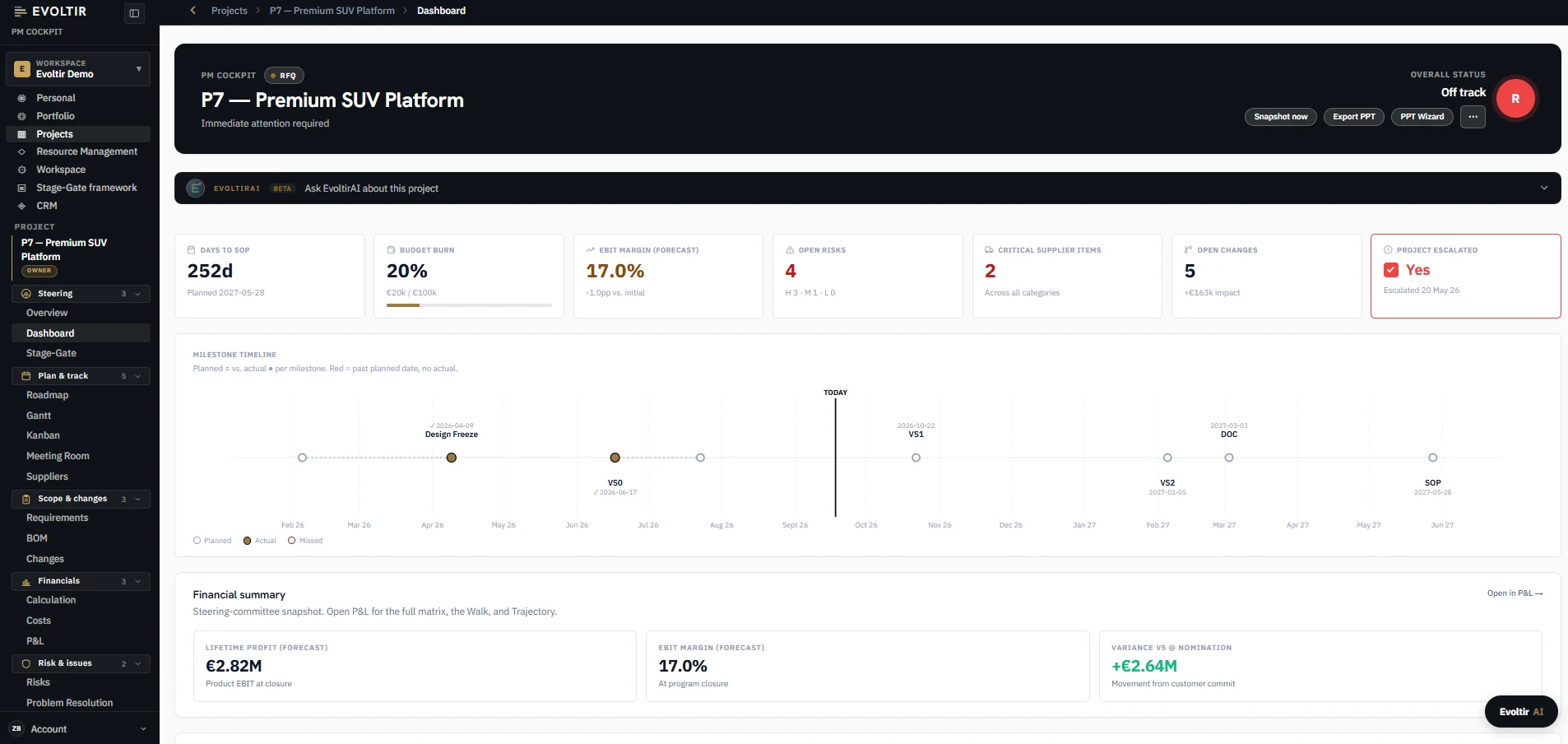
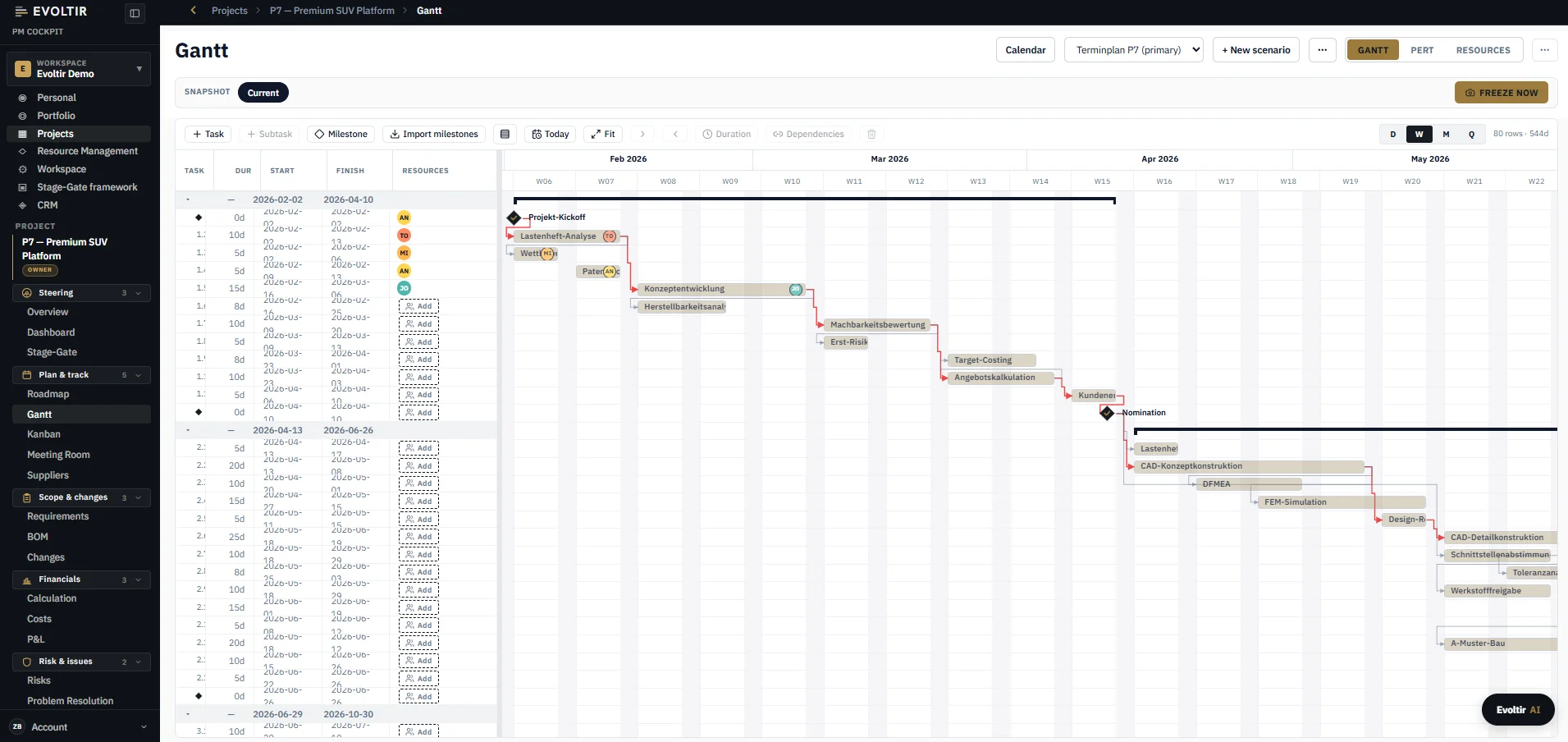
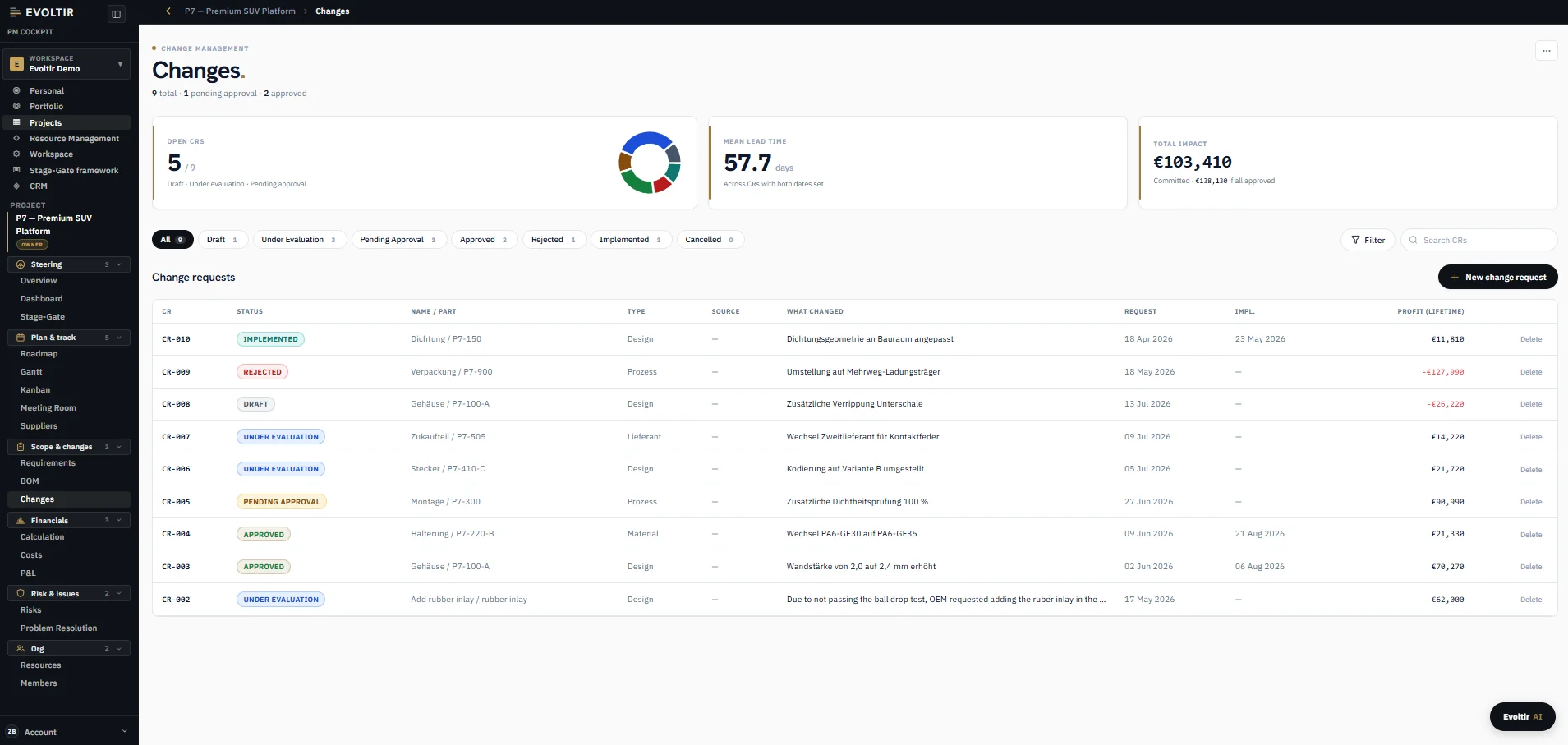
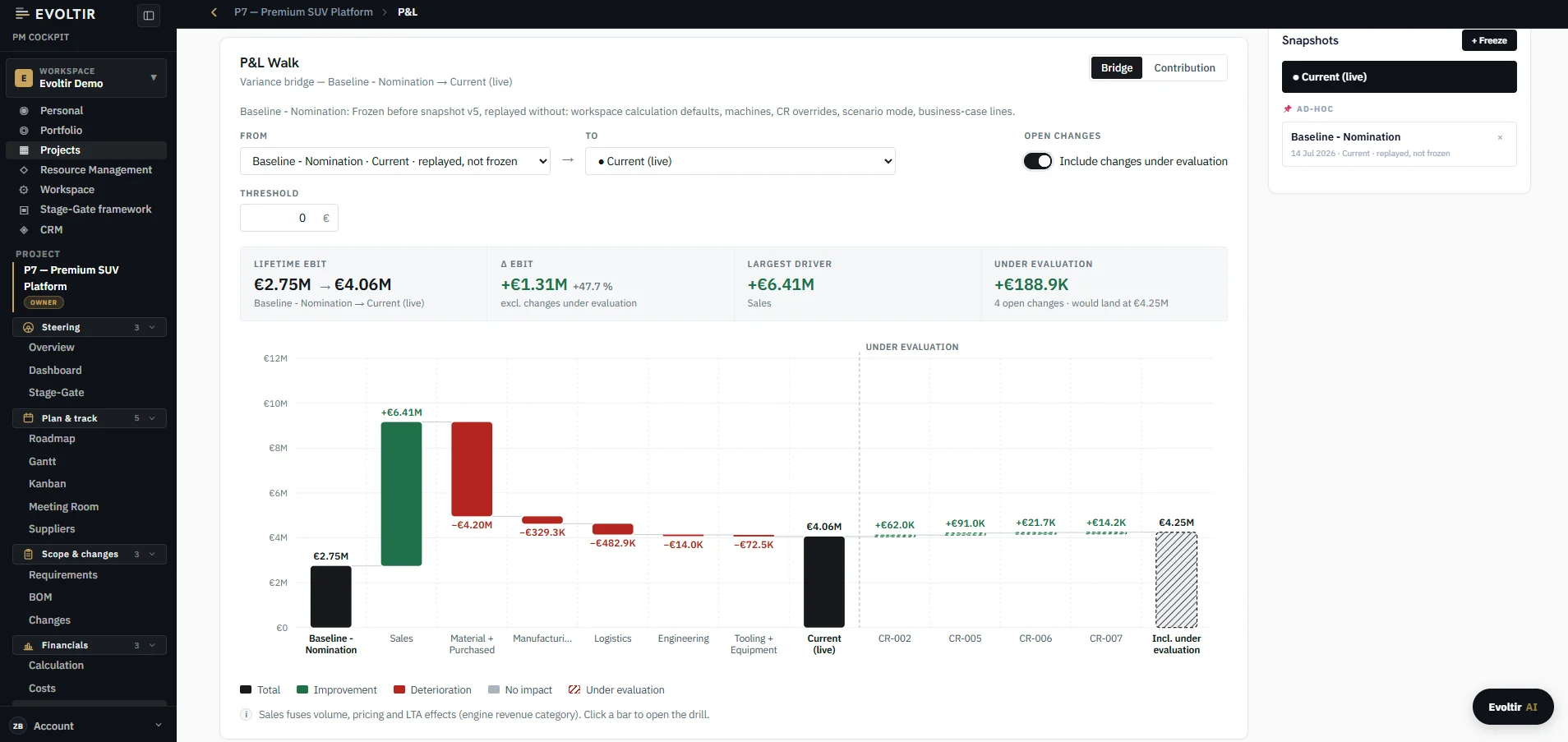
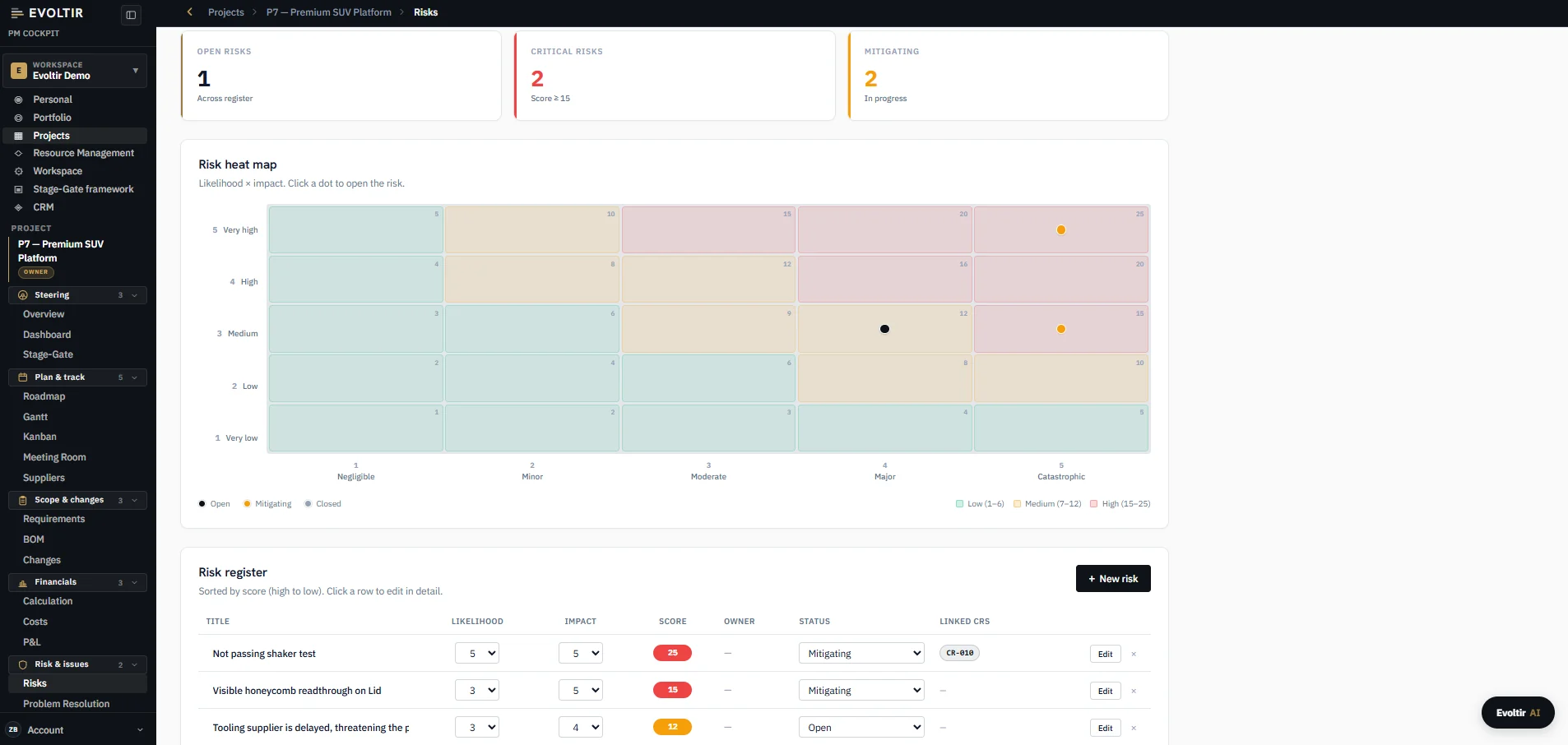
Other systems solve individual parts of project steering. Evoltir connects all six domains in one system.
The strength lies in the connections.
A change does not stay in the change tracker. A schedule deviation does not stay in the Gantt chart. Their effects become visible everywhere they influence the project, in the same system.
Schedule → Resources → Portfolio
The conflict becomes visible before several project managers plan the same capacity at the same time.
Change → Cost → P&L
The commercial impact is decided before the change is approved.
Execution → Management → Execution
Reporting is no longer a separate process.
Decisions turn into progress.
Transparency achieves little if nothing follows from it. In Evoltir, decisions become actions, with clear ownership, a due date and tracking through to closure.
Deliverables with owners and transparent status
Every approval is assigned to an owner and traceable with date and history.
Steering changes from approval through to implementation
Approvals, impacts and implementation stay connected and traceable.
Critical items stay visible until they are resolved
Open items, owners and escalations are tracked centrally until a resolution is reached.
Resource gaps become concrete requests and allocations
Demand, approval and allocation run in one shared process. Project and department leadership work with the same numbers.
Tracking open items consistently through to closure
Actions are tracked with an owner and due dates until the problem is actually solved.
Steering margin levers deliberately
Cost reductions and changes are tracked with their commercial impact and linked directly to the P&L.
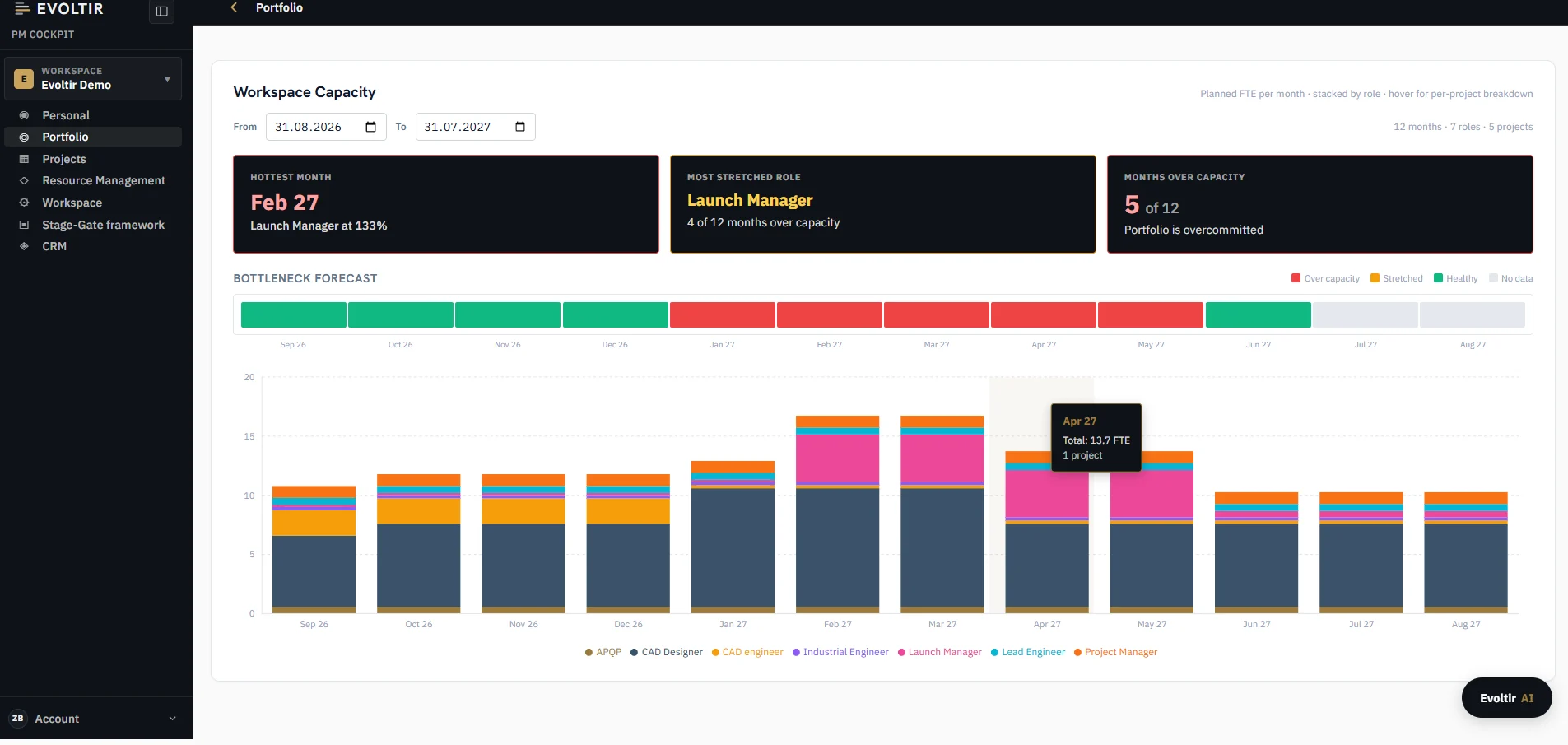
When five projects compete for the same engineers.
Project accountability sits with the project manager, resource accountability with the departments. Without a shared view, capacity gets negotiated between projects and conflicts only surface when the schedule is already at risk.
Evoltir brings resource demand, approvals and allocations into one shared process. Demand is planned by role and period, routed to department leadership, approved and assigned to named people.
When several projects compete for the same resources, scenarios can be compared directly: move dates, change priorities or replan projects before the conflict reaches the gate.
Project accountability without access to resources is not real steering.
Seeing where the portfolio needs attention.
A PMO steers many projects at once, in different phases and with shared bottlenecks in budget and capacity. What matters is which commitments are at risk and where leadership has to intervene.
Every project steered in Evoltir feeds the portfolio view automatically: gate status, schedule adherence, margin development, capacity utilization and open escalations.
- Portfolio status at a glance. Every project assessed by schedule, gate maturity, margin and capacity.
- Cross-project risks. Supplier or capacity problems become visible as soon as they affect several projects at once.
- Management decisions prioritized. Open decisions are bundled where leadership has to intervene.
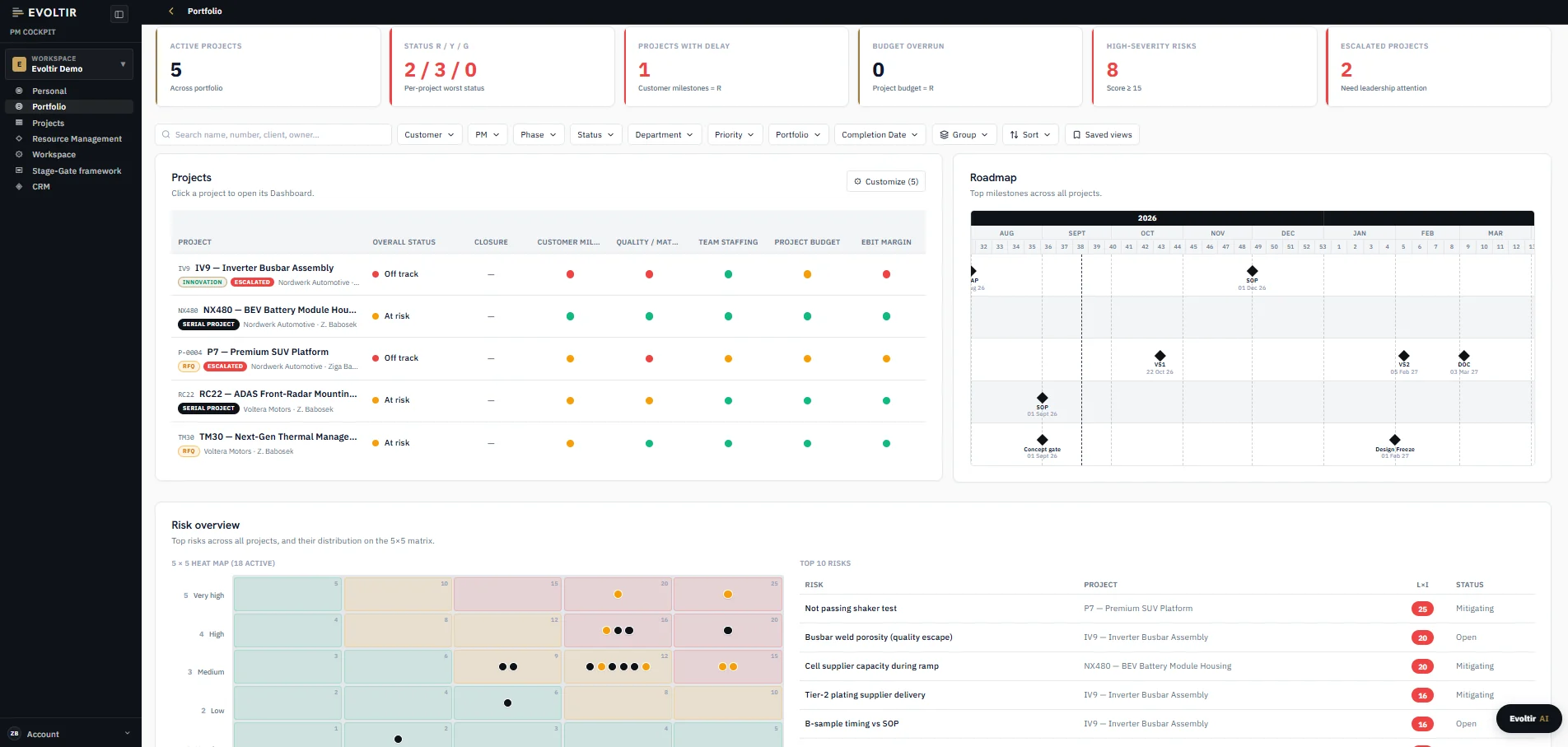
The portfolio view is generated directly from current project data and does not need to be maintained as a separate reporting layer.
One project reality. Multiple views.
Evoltir is built on one shared data model for the entire project. Schedules, resources, risks, changes, cost and decisions are maintained once and available in every view.
Leadership gets transparency. Every team member gets clarity.
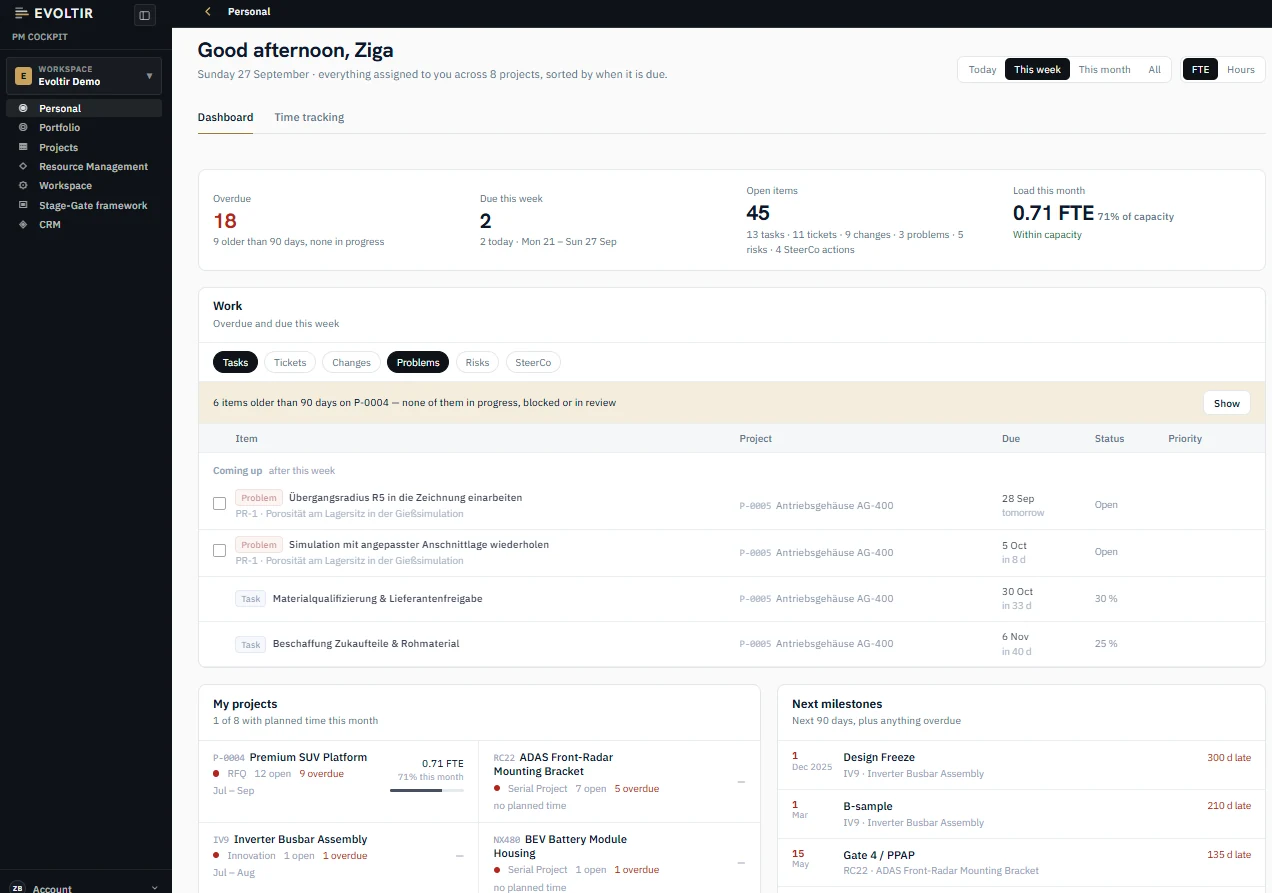
Project work and project steering run in the same system. When tasks are completed, decisions taken or changes implemented, the project status updates itself.
Industrial project steering, ready in the system.
Evoltir already contains the core structures of industrial project steering: gates, roles, approvals, risks, changes and resource processes. Your PMO adapts them instead of building them from scratch.
Blank workspace
Evoltir PM steering model
EvoltirAI becomes the project memory of your organization.
EvoltirAI works with the knowledge from your own projects, from decisions and risks through to changes, cost and actions. It structures new projects from existing documents and supports decisions with evidence from your own history.
Identifies the supplier delay, the gate readiness, similar prior projects, the countermeasures and the decision context.
Searches risks, CRs, supplier milestones, gate notes, actions, P&L movements and prior decisions the user is allowed to see.
Returns the prior cases with their source references, drawn from your own workspace.
Drafts a risk, a task, a briefing or a follow-up. Nothing is written until the user confirms.
Not a chatbot beside the product. The brain inside it.
EvoltirAI works on your own workspace: the requirements, schedules, risks, change requests, suppliers, costs and decisions your teams actually create. It does three things with that, and each one runs inside the same permissions and audit trail as the rest of the platform.
The project assembles itself from your documents.
Upload a requirements specification, a BOM or a supplier schedule. EvoltirAI extracts the structure, requirements, parts, milestones and dates, and turns it into a working project instead of a blank template. Imports run into searchable memory, scoped to the workspace or project, so the same documents also answer questions later.
It creates real work, inside your governance.
Ask it to log a risk or open a task, by typing or by voice. It proposes the item on a confirmation card, you approve it, and only then is it written, re-checked against your role and recorded in an action log. Nothing is written without a human confirming it, and every AI write is traceable.
Every program makes the next one sharper.
Ask in plain German or English and it retrieves across every program in the workspace, comparing similar risks, change requests, suppliers and gate gaps, and answering with citations to the real records. A new project manager reaches the organization’s experience on day one. It stays when people leave.
Runs on AWS Bedrock in the EU. Workspace-isolated, permission-aware retrieval, a full audit trail, a hard kill switch, and no training on your data across customers.
You do not need the whole system on day one.
Start with one real program and one costly steering problem. Expand once the operating logic has proven itself on your own data. Most teams move through these phases in order.
Steering visibility
Replace static reporting with a live cockpit, status discipline and decision-ready views.
Resource governance
Make demand, approvals and bottlenecks visible across one program or a portfolio slice.
CR and profitability
Connect change requests to cost impact, P&L movement and recovery decisions.
Gates and readiness
Move gate reviews from slide ceremonies to evidence-based steering events.
See how one program solved one costly steering problem.
Each playbook walks one real steering problem end to end, with the numbers: how it surfaced, what the decision was, and what it saved. Written to read on your own and share with the people who sign off.
Bring one real program. We map it into the steering system.
One program, one steering cycle and one costly problem: visibility, capacity, gates, profitability or supplier control. We show you the system working on your own program.